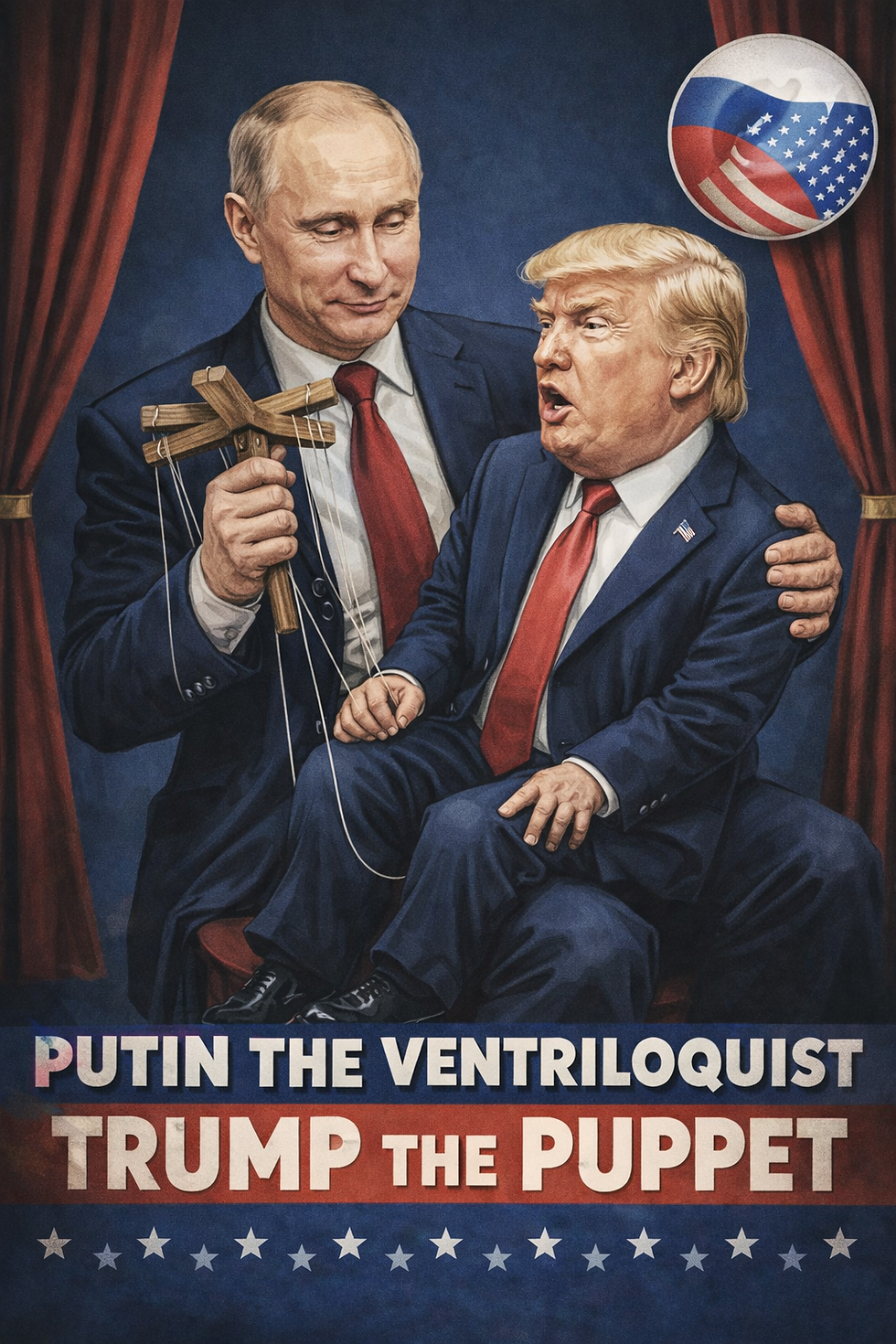
Trump is Putin’s Puppet
- Don Hilborn
- Feb 22
- 4 min read

Introduction
I actually enjoy debating politics — especially with people who come in hot on emotion but light on evidence. You’d think they’d conserve their energy once they realize I don’t tire out in arguments; I get sharper. My baseline rule is simple: I’m not interested in feelings — mine or yours. Show me independently verifiable evidence. That’s usually the moment the conversation shifts from substance to name-calling, and eventually it fades out.
Recently, though, something different happened. I responded to a post with a blunt statement: “Trump is Putin’s puppet.” A now-former MAGA supporter challenged me using my own standard: “Nobody cares what you feel. What evidence do you have?”
Fair question — and exactly the right one. Because this issue shouldn’t be decided by tribal loyalty, partisan instinct, or social-media narratives. It should be evaluated the same way any serious claim is evaluated: through documented facts, intelligence findings, bipartisan congressional reports, policy outcomes, and strategic analysis.
What follows isn’t speculation, conspiracy talk, or emotional rhetoric. It’s a structured presentation of credible evidence showing that — repeatedly and across multiple domains — Donald Trump’s public statements, policy decisions, and geopolitical positioning aligned with objectives long identified as core strategic goals of Vladimir Putin’s Russia. Whether one interprets that alignment as coincidence, ideology, political calculation, or something more concerning is up to the reader.
But the alignment itself is documented. And that’s where the conversation should start.
1) U.S. Intelligence and Bipartisan Congressional Findings: Russia preferred Trump and acted to help him
The U.S. Intelligence Community assessed that Putin ordered an influence campaign aimed at the 2016 election, with goals including undermining faith in U.S. democracy and developing a “clear preference” for Trump.[1]
The bipartisan Senate Intelligence Committee later affirmed core analytic judgments of the 2017 Intelligence Community Assessment (ICA), reinforcing that the assessment’s central conclusions were sound.[2]
Why this matters for “tandem with Putin’s goals”: Even before you get to Trump’s choices, the Kremlin’s own strategic aim (help Trump / hurt Clinton / destabilize trust) is a foundational premise established by U.S. intelligence and reviewed by Congress.[1][2]
2) The Mueller Record: Extensive campaign links; Russia’s “sweeping and systematic” interference
Special Counsel Mueller concluded that the Russian government interfered in “sweeping and systematic fashion.”[3] The report also details numerous contacts and episodes (e.g., the Trump Tower meeting) that demonstrate the campaign’s receptivity to Russia-linked outreach, even though Mueller did not establish a criminal conspiracy/coordination charge on the evidence available under that legal standard.[3]
Why this matters: Putin’s objective wasn’t “prove a conspiracy in U.S. court.” It was to shape U.S. outcomes and degrade democratic legitimacy—and the Mueller report documents how Russia pursued that objective and how the Trump orbit intersected with it.[3]
3) Helsinki 2018: Trump publicly undercut U.S. intelligence alongside Putin
At the Helsinki joint press conference, Trump’s public posture was widely criticized because it elevated/validated Putin’s denial of election interference in a way that cut against U.S. intelligence conclusions.[4]
Why this matters: A core Kremlin goal is information warfare—confusing attribution, creating “nothing is true” fog, and weakening Western institutional credibility. A U.S. President publicly discounting U.S. intelligence advances that goal even if you assume no covert coordination.[4]
4) Ukraine pressure + aid hold: A documented act that objectively benefited Russia’s strategic position
The Government Accountability Office (GAO) found that OMB’s withholding of congressionally appropriated Ukraine security assistance violated the Impoundment Control Act.[5] The House impeachment inquiry report documents the pressure campaign and linkage of official acts to Ukraine announcements/investigations.[6]
Why this matters: Putin’s grand strategy is to subordinate Ukraine and reduce Western support. Withholding military aid to Ukraine—even temporarily—materially aligns with Russia’s objectives, independent of motive.[5][6]
5) Weakening NATO credibility: a long-running Kremlin objective repeatedly echoed in Trump’s posture
Analysts at Brookings and others documented Trump’s persistent skepticism of NATO and the risks of signaling uncertainty around collective defense commitments.[7]
Why this matters: Undermining NATO unity and confidence is a textbook Russian strategic aim. When a U.S. President signals doubt about alliance commitments, it can shift incentive structures in exactly the direction Russia seeks (deterrence erosion, allied hedging, reduced cohesion).[7]
6) Sanctions posture: documented delays/reluctance in applying Russia sanctions required by law
Reporting documented episodes where the Trump administration was criticized for delays or reluctance in implementing sanctions measures targeting Russia, despite congressional pressure and statutory deadlines.[8][9]
Why this matters: Russia’s objective is to reduce economic and diplomatic constraint. A posture perceived as slow-rolling sanctions predictably serves Kremlin interests.[8][9]
7) Normalizing Russia internationally: pushing for Russia’s return to G7 (G8)
Trump publicly supported re-admitting Russia to the G7 (returning to a G8 format), framing Russia’s expulsion as a mistake.[10]
Why this matters: One of Putin’s durable goals is re-legitimation—being treated as a normal great-power partner despite aggression in Ukraine. Re-entry advocacy supports that aim.[10]
😎 Crimea rhetoric: statements that track Kremlin narratives
Trump was reported as making remarks consistent with a pro-Kremlin framing about Crimea (e.g., suggesting Crimeans prefer Russia / questioning whether the U.S. should recognize Russian control).[11] Reporting also described statements attributed to him at the G7 consistent with treating Crimea as “part of Russia.”[12]
Why this matters: Crimea is a flagship legitimacy claim for Putin. Rhetoric that softens non-recognition norms aligns with Moscow’s preferred narrative and weakens Western red lines.[11][12]
9) Syria withdrawal consequences: analysts noted openings for Russia/Assad/Iran influence
Policy analyses of the 2019 Syria drawdown emphasized that the decision created openings in which Russia and the Assad regime could expand influence as U.S. leverage declined.[13][14]
Why this matters: Russia seeks to displace U.S. influence in key theaters and present itself as the indispensable power broker. Reduced U.S. presence in Syria predictably advances that objective.[13][14]
10) Arms-control / transparency architecture: Open Skies withdrawal reduced a tool favored by many allies
The U.S. withdrawal from the Open Skies Treaty under Trump was criticized as harmful to European security architecture and allied preferences, even acknowledging Russian compliance issues.[15]
Why this matters: Putin’s strategic interest is to fracture Euro-Atlantic coordination and constrain transparency regimes on terms favorable to Russia. Even when justified on compliance grounds, a U.S. exit that alienates allies can still align with Kremlin preference for alliance friction.[15]
Citations (full URLs)


Comments